Showing posts with label sell silver. Show all posts

Wednesday, January 26, 2011

5 Rare and Valuable US Coins

Have fun going through your old jars of coins.  You never know what you might find hidden in your collection.  This is taken from an article on www.blifaloo.com   
5 Rare and Valuable US Coins 

1943 Copper Penny

Coin: 1943 Copper Penny
Estimated Value: $10,000 - $100,000+
Background: Most circulating pennies at that time were struck in zinc-coated steel because copper and nickel were needed for the the war.
About 40 1943 copper cents are estimated to remain in existence, and only about a dozen confirmed to exist.
They were most likely made by accident when copper blanks remained in the press as production began on the new steel pennies.
In 2008, Steve Contursi sold a 1943-S authenticated copper wheat penny for more than $100,000 to a private collector. Contursi had bought the coin only a week earlier for about $72,000. 
How to spot it: The easiest way to determine if your 1943 cent is copper (and valuable) is to test it with a magnet. If it sticks to the magnet, it is a steel penny, and not valuable (but still pretty nifty).
If it does not stick, then you might have hit the jackpot...have a expert authenticate your coin, but be prepared for disappointment: there are probably many counterfeits of this coin. More info about 1943 Pennies on Wikipedia

1982 "No P" Dime
Coin: 1982 "No P" Dime
Estimated Value: $100+ (just saw one on ebay for $3000)

Background: Before 1980, dimes minted in Philadelphia didn't have a mint mark. Starting that year, a small letter "P" was placed on Philly dimes above the date.
In 1982 an error occurred when the mint mark was omitted from a small number of dimes, leaving them p-less.
How to spot it: 1982 dime, with no "p" above the date. Of course, this could be easy to fake -- an expert would need to authenticate the coin.

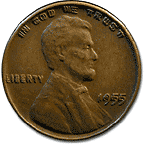
1955 Double Die Penny

Coin: 1955 Double Die Penny
Estimated Value: $300 - $25,000+

Background: Double dies are caused when from a misalignment during the production of a coin.
About 24,000 1955 double die cents were put into circulation.
In uncirculated condition, the 1955 Double Die wheat penny is worth over $25,000. Even circulated versions of the 1955 Double Die are worth $300-$1000+ depending on condition.
How to spot it: The doubling of the letters and numbers on this coin is pretty easy to see. Rare, but not too rare... these pop-up at auction every once and a while.


2001-P Double Struck New York Quarter

Coin: 2001-P Double Struck New York Quarter
Estimated Value: $400 - $3000


Background: The coin is sadistic and is not satisfied being struck once. A production goof keeps the coin in the chamber for extra striking making a very odd looking coin.
How to spot it: Off center image doubling of Washington and the Statue of Liberty.

1965 Silver Dime

Coin: 1965 Silver Dime
Estimated Value: $9000+
Background: The official production of silver dimes were discontinued in 1964.
Beginning in 1965 dimes were made out of copper and nickel. A silver 1965 dime is a mistake (and a rare one).
Only a few have been found, but more are believed to still be in circulation.
How to spot it: The silver coin has a silver edge; the common copper/nickel coin has a strip of brown around the edge.
A silver dime weighs 2.50 grams, while a copper/nickel dime weighs 2.27 grams
 

Saturday, January 22, 2011

The 1933 Gold Double Eagle - World's Most Valuable Coin

This is reprinted from an About.com Guide article by Susan Headley 

The 1933 Gold Double Eagle was Never Officially Issued:

The U.S. Gold Double Eagle, Saint-Gaudens type, had been issued from 1907 until 1932. Although 445,500 Double Eagles had been minted with the 1933 date, none were released into circulation because of changes made to currency laws during the Great Depression. In an effort to end the run on the banks and stabilize the economy, President Franklin Roosevelt took America off the gold standard. Not only were no more gold coins to be issued for circulation, people had to turn in the ones they had.

The 1933 Double Eagles are Ordered to be Destroyed:

It became illegal for private citizens to own gold coins, unless they clearly had a collectible value. This law was enacted during desperate times to prevent the hoarding of gold currency. Since there would be no more gold currency issued in the U.S., the Mint had melted down the 1933 run of Gold Double Eagles and converted them to gold bullion bars by 1937.

Some of the Double Eagles Escaped the Melt Down:

Two of the 1933 specimens were given by the Mint to the U.S. National Numismatic Collection at the Smithsonian Institute. These were the only two legal specimens to ever become part of a coin collection; however, by 1952, the Secret Service had confiscated 8 more 1933 Double Eagles! How did they leave the Mint? Why weren't they melted down?

Was the 1933 Double Eagle Switched for Another Coin?:

We may never know for certain how these coins left the Mint, but there is a general consensus among scholars that a Mint cashier by the name of George McCann exchanged about 20 1933's doomed for destruction and replaced them with earlier dated Double Eagles. This way, the accounting books would balance and nobody would realize that anything was amiss.  What we do know for sure is that a Philadelphia area jeweler by the name of Israel Switt came into possession of at least 19 of the coins.

The Coin of a King:

Israel Switt sold at least 9 of the 1933 Double Eagles privately to collectors, one of which found its way into the collection of King Farouk of Egypt. When the Secret Service discovered that these coins had surfaced, they confiscated them all because they were considered to be stolen property of the U.S. Mint. However, King Farouk had legally exported his coin before the theft was discovered, and the Secret Service was unable to recover his specimen through diplomatic channels.

The King's Specimen is Recovered in a Sting Operation:

After King Farouk was deposed in 1952, his 1933 Double Eagle briefly appeared on the market, but when it became clear that U.S. authorities still wanted to confiscate it, it vanished again! More than 40 years later, British coin dealer Stephen Fenton showed up with it in New York, and the Secret Service finally seized it during a sting operation during which they purportedly negotiated to purchase the coin.

The 1933 Double Eagle is Nearly Destroyed by Terrorists:

Fenton fought a several year-long legal battle in the U.S. courts over ownership of the coin, during time which it was stored in the Treasury Vaults at the World Trade Center. A mere 2 months before the terrorist attacks of September 11, 2001, the lawsuit was settled and the Double Eagle was moved to Fort Knox. Fenton and the U.S. Mint had come to a compromise: the coin would be sold at auction, with the proceeds split between the Fenton and the Mint.

Legal Tender at Last - and the Most Valuable Coin in the World:

The 1933 Double Eagle sold at auction on July 30, 2002, for $6.6 million, plus the 15% buyer's fee, which brought the total cost to the buyer to $7,590,000, plus $20 to monetize the coin and compensate the Mint for the $20 it believes it lost when the coin was thought to have been stolen. The buyer chose to remain anonymous, so once again we don't know where the Farouk specimen is, or when it might suddenly show up again. One thing is for sure: the Secret Service can't confiscate it any more!
In September of 2004, Joan Langbord, one of Israel Switt's heirs, discovered ten more specimens of the 1933 Double Eagle amongst his effects. Apparently unaware of the legal status of these coins (or perhaps just a bit too trusting of the government) she sent all ten specimens to the U.S. Mint to have them authenticated. The Secret Service declared the coins to be seized, and now Langbord is fighting the government over ownership while the specimens languish at Fort Knox. It will be interesting to see, should the 10 Langbord coins ever come to market, if the 1933 Double Eagle will retain its place as the world's highest priced coin when the number of available specimens increases ten-fold.

http://www.usacoinbuyers.com/

Friday, January 21, 2011

Coin Grading Guide: Walking Liberty

This article is taken from the NGC's website.  We hope you will enjoy this unique review of our nation’s coinage.

Grading Walking Liberty Half Dollars (1916-1947)


Almost everyone's short list of favorite coin types includes the Walking Liberty half dollar. The United States Mint didn't share that view, however, as coins of this type were very difficult to strike; even proofs sometimes lacked complete details.

The Mint's Engraving Department attempted to correct this problem by sharpening the obverse master hub on several occasions, but the fundamental problem of poor metal flow into the dies proved insurmountable. This fact presents a challenge when attempting to grade Walking Liberty halves, as many of the pieces coined during the 1920s and earlier seem worn even when fully lustrous. This also is true of some of the branch mint issues of the '30s and '40s, particularly those coined at the San Francisco Mint.

Circulated halves are quite popular with collectors, though these coins did not wear evenly and can be unattractive in grades below Fine. The guidelines and photographs presented in The Official American Numismatic Association Grading Standards for United States Coins are very useful in determining the grades of circulated coins. This book also offers detailed descriptions of each Mint State grade level, though the most effective teaching tool is always hands-on experience.

The figure of Liberty and the eagle were both quite susceptible to contact marks from other coins, both before and after leaving the mint. These elements are in high relief and received only slight protection from the raised rims. As with any coin type, the Walking Liberty half dollar features certain areas where contact marks or hairline scratches have a greater impact on grading than they do in other areas. These are described in the ANA's guide as Prime Focal Areas and include the obverse field at the right (above the motto IN GOD WE TRUST) and the eagle's breast, left leg and left wing. Any surface disturbance occurring in these areas weighs heavily in lowering a coin's grade. Secondary Areas include the obverse field at the left, the sun's face and rays, Liberty's right arm, the flag drapery below it and the date area. Contact marks or hairline scratches located in these places still affect a coin's grade, but to a lesser degree.

Toning also is a grading issue with Walking Liberty halves. Coins of this type typically tone in an irregular and sometimes quite unattractive pattern. They're not likely to produce the beautiful concentric circles found on simpler designs. That's why you won't see very many toned Walkers in the marketplace, as many such coins have been "dipped" at some point to remove blotchy toning. There are exceptions, of course, and attractively toned examples may earn an extra grading point or the NGC star designation for superior eye appeal. Still, you should not be put off by dipped coins, particularly if their mint luster is unimpaired.

With their areas of exposed relief, Walking Liberty halves are particularly vulnerable to light stacking friction, or "rub" as it's sometimes called. This typically appears on Liberty's breasts, the breast and upper left leg of the eagle and the rims. Before the advent of certified grading, coins with such rub frequently were sold as mint state examples. These "sliders" are now graded AU-58, and that grade was devised specifically to describe such coins.
Before I conclude this discussion, a few additional words about striking quality are essential. The greatest deficiency in metal flow typically occurred at Liberty's left hand and the branch stem on the obverse, and at the eagle's breast and left leg on the reverse. Only on proofs dated 1936-42 are all of these elements brought up well, yet even some proofs are a bit indistinct in the shape of Liberty's hand. Many Denver and San Francisco Mint coins show additional weakness in Liberty's head, the olive branch and the date area. If severe, such weakness can lower the grade of a Mint State coin, and it can impair the wearing quality of circulated coins as well.

If you have any questions about buying or selling Walking Liberty half-dollars, please send us an email at info@usacoinbuyers.com and we can help you.

Wednesday, January 19, 2011

America The Beautiful Quarters

America the Beautiful Quarters Program is a multi-year initiative to honor 56 national parks and other national sites in each state, the District of Columbia and U.S. territories—Puerto Rico, Guam, American Samoa, United States Virgin Islands and the Northern Mariana Islands.  Under this program, five new reverse designs will appear on the quarter-dollar each year beginning in 2010 and through 2021.

For 2011, the coins will feature Gettysburg National Military Park in Pennsylvania, Glacier National Park in Montana, Olympic National Park in Washington, Vicksburg National Military Park in Mississippi, and Chickasaw National Recreation Area in Oklahoma..

Release dates for each of the issues are now also available. The dates listed below represent the official dates that the coins may be released into circulation.  Official launch ceremonies for each quarter have usually been held on or shortly after the circulation release date, at the park or a related location.

The following information about individual quarters was taken from the US Mint site:

The Gettysburg National Military Park quarter is the first to be released in 2011. The Battle of Gettysburg was a turning point in the Civil War, the Union victory in the summer of 1863 that ended General Robert E. Lee's second and most ambitious invasion of the North. Often referred to as the "High Water Mark of the Confederacy," it was among the war's bloodiest battles, with 51,000 casualties. It also provided President Abraham Lincoln with the setting for his most famous address. It was the Gettysburg Battlefield Memorial Association, a group of concerned citizens, that first set out in 1864 to preserve the battlefield as a memorial to the Union troops who fought there. The park is well-known for its many monuments and memorials, the majority of which were placed by veterans of the battle. On February 11, 1895, the battlefield was transferred to the federal government as Gettysburg National Military Park (28 Stat. 651).
America the Beautiful Quarters Program - Gettysburg National Military Park reverse
The reverse image depicts the 72nd Pennsylvania Infantry Monument, which is located on the battle line of the Union Army at Cemetery Ridge. Inscriptions are GETTYSBURG, PENNSYLVANIA, 2011 and E PLURIBUS UNUM.

The Glacier National Park quarter is the second to be released in 2011. The park is named for its prominent glacier-carved terrain and remnant glaciers descended from the ice age of 10,000 years ago. Glacial forces, ancient seas, geologic faults and uplifting all combined to create some of the most spectacular scenery on earth. Known to the Blackfeet as the "Backbone of the World," Glacier National Park preserves more than 1 million acres of forests, alpine meadows, lakes, rugged peaks and glacially carved valleys in the Northern Rocky Mountains. These lands were first set aside as a national reserve on February 22, 1897 (29 Stat. 907).
America the Beautiful Quarters Program - Glacier National Park reverse
The reverse image depicts a classic view of the northeast slope of Mount Reynolds towering in the distance, while a mountain goat clamors over the rocky slopes of the park's high country. Inscriptions are GLACIER, MONTANA, 2011 and E PLURIBUS UNUM. Design candidates were developed in consultation with representatives of Glacier National Park.

The Olympic National Park quarter is the third to be released in 2011. From glistening tidepools to glacier-capped peaks, Olympic National Park protects more than 70 miles of Pacific Ocean beaches and, less than 33 miles away, the glacier-capped 7,980-foot summit of Mount Olympus that is the heart of the Olympic range. The park consists of coastline, rugged peaks, meadows and lakes, scattered forests and steep forested slopes ending in broad, U-shaped valleys. Geology, climate, isolation, history and sheer size mean this nearly 1 million-acre park protects relatively intact ecosystems, making it a priceless living laboratory and a home for plants and myriad species of animals large and small. It was first established as a national site on February 22, 1897 (29 Stat. 901).
America the Beautiful Quarters Program - Olympic National Park reverse
The reverse image depicts a Roosevelt elk standing on a gravel river bar of the Hoh River with a view of Mount Olympus in the background. Inscriptions are OLYMPIC, WASHINGTON, 2011 and E PLURIBUS UNUM. Design candidates were developed in consultation with representatives of Olympic National Park.

The Vicksburg National Military Park quarter is the fourth released in 2011. The park commemorates one of the pivotal battles of the Civil War — the campaign, siege, and defense of Vicksburg, Miss. Surrender on July 4, 1863, coupled with the fall of Port Hudson, La., split the South, giving control of the Mississippi River to the North. The museum exhibits at the park depict the hardships of civilians and soldiers during the devastating 47-day siege of the city. More than 1,350 monuments, a national cemetery and the restored Union ironclad gunboat, the U.S.S. Cairo, mark the 16-mile tour road. The U.S.S. Cairo was the first warship sunk by an electronically detonated "torpedo," which ushered in a new age of naval warfare. Vicksburg was first established as a national site on February 21, 1899 (30 Stat. 841).
America the Beautiful Quarters Program - The Vicksburg National Military Park reverse
The reverse image depicts the U.S.S. Cairo on the Yazoo River as it would have been seen when it served the U.S. Navy during the Civil War. Inscriptions are VICKSBURG, MISSISSIPPI, 2011 and E PLURIBUS UNUM. Design candidates were developed in consultation with representatives of Vicksburg National Military Park.


The Chickasaw National Recreation Area quarter is the fifth released in 2011 and the 10th overall in the America the Beautiful Quarters® Program. The 7th national park established in the U.S., the park is unique in that it was founded through the support of an Indian tribe, the Chickasaw Nation. Chickasaw National Recreation Area exists as a part of the national park system to provide for the protection of the area's unique resources, springs, streams, lakes and other natural features; to protect and interpret its cultural history, historic landscapes and structures; to commemorate the Chickasaw Nation; and to provide for public education, appreciation and recreational use and enjoyment of those resources. It was originally established as a national site on July 1, 1902 (32 Stat. 641).
America the Beautiful Quarters Program - Chickasaw National Recreation Area reverse
The reverse image depicts the Lincoln Bridge, built of limestone and dedicated in 1909 to celebrate the centennial of Abraham Lincoln's birth. The bridge is the first constructed improvement in the national recreation area and a favorite scenic spot. Inscriptions are CHICKASAW, OKLAHOMA, 2011 and E PLURIBUS UNUM. Design candidates were developed in consultation with representatives of Chickasaw National Recreation Area.

Thursday, January 13, 2011

Proof Sets

What is the difference between the United States Mint Proof Set and the United States Mint Silver Proof Set?


Both coin sets use the same "proof" manufacturing process, and both contain the same number of coins. However, the United States Mint Proof Set is made with the same metal alloys that the United States Mint uses to produce coins for general circulation.

The Roosevelt dime, Kennedy half-dollar, and the quarters contained in the United States Mint Silver Proof Set are minted in 90% silver alloy.

SILVER Proof Set