Showing posts with label sell coins. Show all posts

Saturday, February 5, 2011

Two Examples of Art Deco Medals

This article is taken from the February 2011 issue of The Numismatist by Larry Johnson & Barbara Gregory

Two medals struck in the 1930's are like day and night.

Quite honestly, the silver-plated medal issued to commemorate the 25th anniversary of General Motors in 1933 is one of the most beautiful examples of the Art Deco style I have seen.  Springing from the imagination of Norman Bel Geddes (1893-1958), the design features an abstract vehicle in motion, with a tall, winglike element lending a feeling of speed and movement.  The reverse shows a stylized piston.  Bel Geddes was trained as a theatrical set designer, but is best known for another General Motors project- the "Futurama" exhibition at the 1939 New York World's Fair.

In stark contrast is the medal struck to celebrate the 10th anniversary of National Broadcasting Company (NBC) in 1936.  The Art Deco flavor is apparent, and the style of the lettering along the reverse perimeter is very similar, but the piece is as heavy and drab as the General Motors specimen is ethereal.  Nevertheless, the NBC medal exudes a sense of strength and is not without its charm.  In some respects, it serves as a bridge between the Art Deco and Modernist movements.  Together, they make a powerful statement.

Tuesday, February 1, 2011

So Called Dollars

This article is taken from the book So-Called Dollars by Harold E. Hibler and Charles V. Kappen.

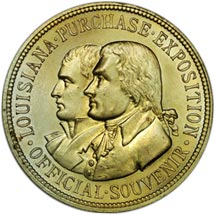
For the last 85 years or more, coin collectors and dealers alike have used the term "so-called dollars" to designate metals of near-dollar size; at first of a commemorative or exposition nature, later of a monetary kind.  Extension of the term now includes certain kindred pieces not otherwise classified specifically.  Perhaps the first written use of the label was by Thomas Elder, New York coin dealer in his sale of Sept 27-28, 1912, in describing Lot 395, the Theodore Roosevelt medal of the 1904 Louisiana Purchase Exposition, St. Louis.  Such items long since have grown in popularity and importance to the extent that they have achieved an independent status and represent a separate and distinct series of their own.


Since the days of the Roman Empire, medals have been prized for their aesthetic value and for centuries artists have found an eternal challenge in this medium of expression.  Certainly in our country there have been numerous outstanding sculptors, known as such to connoisseurs of American art but identified by numismatists largely as coin designers or medalists.  The very freedom of thought and expression provided these artists has produced many so-called dollars of diverse and rare beauty.  Pursuit of such a collection, while sometimes difficult is most rewarding.

Wednesday, January 26, 2011

5 Rare and Valuable US Coins

Have fun going through your old jars of coins.  You never know what you might find hidden in your collection.  This is taken from an article on www.blifaloo.com   
5 Rare and Valuable US Coins 

1943 Copper Penny

Coin: 1943 Copper Penny
Estimated Value: $10,000 - $100,000+
Background: Most circulating pennies at that time were struck in zinc-coated steel because copper and nickel were needed for the the war.
About 40 1943 copper cents are estimated to remain in existence, and only about a dozen confirmed to exist.
They were most likely made by accident when copper blanks remained in the press as production began on the new steel pennies.
In 2008, Steve Contursi sold a 1943-S authenticated copper wheat penny for more than $100,000 to a private collector. Contursi had bought the coin only a week earlier for about $72,000. 
How to spot it: The easiest way to determine if your 1943 cent is copper (and valuable) is to test it with a magnet. If it sticks to the magnet, it is a steel penny, and not valuable (but still pretty nifty).
If it does not stick, then you might have hit the jackpot...have a expert authenticate your coin, but be prepared for disappointment: there are probably many counterfeits of this coin. More info about 1943 Pennies on Wikipedia

1982 "No P" Dime
Coin: 1982 "No P" Dime
Estimated Value: $100+ (just saw one on ebay for $3000)

Background: Before 1980, dimes minted in Philadelphia didn't have a mint mark. Starting that year, a small letter "P" was placed on Philly dimes above the date.
In 1982 an error occurred when the mint mark was omitted from a small number of dimes, leaving them p-less.
How to spot it: 1982 dime, with no "p" above the date. Of course, this could be easy to fake -- an expert would need to authenticate the coin.

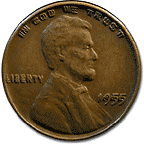
1955 Double Die Penny

Coin: 1955 Double Die Penny
Estimated Value: $300 - $25,000+

Background: Double dies are caused when from a misalignment during the production of a coin.
About 24,000 1955 double die cents were put into circulation.
In uncirculated condition, the 1955 Double Die wheat penny is worth over $25,000. Even circulated versions of the 1955 Double Die are worth $300-$1000+ depending on condition.
How to spot it: The doubling of the letters and numbers on this coin is pretty easy to see. Rare, but not too rare... these pop-up at auction every once and a while.


2001-P Double Struck New York Quarter

Coin: 2001-P Double Struck New York Quarter
Estimated Value: $400 - $3000


Background: The coin is sadistic and is not satisfied being struck once. A production goof keeps the coin in the chamber for extra striking making a very odd looking coin.
How to spot it: Off center image doubling of Washington and the Statue of Liberty.

1965 Silver Dime

Coin: 1965 Silver Dime
Estimated Value: $9000+
Background: The official production of silver dimes were discontinued in 1964.
Beginning in 1965 dimes were made out of copper and nickel. A silver 1965 dime is a mistake (and a rare one).
Only a few have been found, but more are believed to still be in circulation.
How to spot it: The silver coin has a silver edge; the common copper/nickel coin has a strip of brown around the edge.
A silver dime weighs 2.50 grams, while a copper/nickel dime weighs 2.27 grams
 

Saturday, January 22, 2011

The 1933 Gold Double Eagle - World's Most Valuable Coin

This is reprinted from an About.com Guide article by Susan Headley 

The 1933 Gold Double Eagle was Never Officially Issued:

The U.S. Gold Double Eagle, Saint-Gaudens type, had been issued from 1907 until 1932. Although 445,500 Double Eagles had been minted with the 1933 date, none were released into circulation because of changes made to currency laws during the Great Depression. In an effort to end the run on the banks and stabilize the economy, President Franklin Roosevelt took America off the gold standard. Not only were no more gold coins to be issued for circulation, people had to turn in the ones they had.

The 1933 Double Eagles are Ordered to be Destroyed:

It became illegal for private citizens to own gold coins, unless they clearly had a collectible value. This law was enacted during desperate times to prevent the hoarding of gold currency. Since there would be no more gold currency issued in the U.S., the Mint had melted down the 1933 run of Gold Double Eagles and converted them to gold bullion bars by 1937.

Some of the Double Eagles Escaped the Melt Down:

Two of the 1933 specimens were given by the Mint to the U.S. National Numismatic Collection at the Smithsonian Institute. These were the only two legal specimens to ever become part of a coin collection; however, by 1952, the Secret Service had confiscated 8 more 1933 Double Eagles! How did they leave the Mint? Why weren't they melted down?

Was the 1933 Double Eagle Switched for Another Coin?:

We may never know for certain how these coins left the Mint, but there is a general consensus among scholars that a Mint cashier by the name of George McCann exchanged about 20 1933's doomed for destruction and replaced them with earlier dated Double Eagles. This way, the accounting books would balance and nobody would realize that anything was amiss.  What we do know for sure is that a Philadelphia area jeweler by the name of Israel Switt came into possession of at least 19 of the coins.

The Coin of a King:

Israel Switt sold at least 9 of the 1933 Double Eagles privately to collectors, one of which found its way into the collection of King Farouk of Egypt. When the Secret Service discovered that these coins had surfaced, they confiscated them all because they were considered to be stolen property of the U.S. Mint. However, King Farouk had legally exported his coin before the theft was discovered, and the Secret Service was unable to recover his specimen through diplomatic channels.

The King's Specimen is Recovered in a Sting Operation:

After King Farouk was deposed in 1952, his 1933 Double Eagle briefly appeared on the market, but when it became clear that U.S. authorities still wanted to confiscate it, it vanished again! More than 40 years later, British coin dealer Stephen Fenton showed up with it in New York, and the Secret Service finally seized it during a sting operation during which they purportedly negotiated to purchase the coin.

The 1933 Double Eagle is Nearly Destroyed by Terrorists:

Fenton fought a several year-long legal battle in the U.S. courts over ownership of the coin, during time which it was stored in the Treasury Vaults at the World Trade Center. A mere 2 months before the terrorist attacks of September 11, 2001, the lawsuit was settled and the Double Eagle was moved to Fort Knox. Fenton and the U.S. Mint had come to a compromise: the coin would be sold at auction, with the proceeds split between the Fenton and the Mint.

Legal Tender at Last - and the Most Valuable Coin in the World:

The 1933 Double Eagle sold at auction on July 30, 2002, for $6.6 million, plus the 15% buyer's fee, which brought the total cost to the buyer to $7,590,000, plus $20 to monetize the coin and compensate the Mint for the $20 it believes it lost when the coin was thought to have been stolen. The buyer chose to remain anonymous, so once again we don't know where the Farouk specimen is, or when it might suddenly show up again. One thing is for sure: the Secret Service can't confiscate it any more!
In September of 2004, Joan Langbord, one of Israel Switt's heirs, discovered ten more specimens of the 1933 Double Eagle amongst his effects. Apparently unaware of the legal status of these coins (or perhaps just a bit too trusting of the government) she sent all ten specimens to the U.S. Mint to have them authenticated. The Secret Service declared the coins to be seized, and now Langbord is fighting the government over ownership while the specimens languish at Fort Knox. It will be interesting to see, should the 10 Langbord coins ever come to market, if the 1933 Double Eagle will retain its place as the world's highest priced coin when the number of available specimens increases ten-fold.

http://www.usacoinbuyers.com/

Thursday, January 20, 2011

Grading Indian Cents (1859-1909)

Here is another article about coin grading.  We often get questions in the store about the value of Indian pennies.
(This article is taken from the NGC's website.)

The Indian Head cent was an American icon for generations, in rare instances circulating as late as the 1950s. After several decades of relative inactivity, these coins have enjoyed renewed popularity in the past dozen years or so. With greater demand for Indian Head cents has come higher values and greater concern about grading.

In circulated grades, this issue is not so complex, as the descriptions and photographs in The Official American Numismatic Association Grading Standards for United States Coins are clear enough that anyone somewhat familiar with coins can easily interpret them.

The biggest issue is how to deal with coins that have been cleaned or damaged. NGC does not certify coins that bear obvious signs of cleaning, whether chemical or abrasive in nature. Damaged and altered coins likewise are rejected for encapsulation. Still, such coins do exist and will continue to be traded. For such pieces an alternative exists in the form of NCS certification. NGC's companion company will provided either details-only grading, with a notation of the problem condition, or simple authentication at the submitter's discretion.

The values for Indian Head cents are such that many collectors can complete all or most of the set in uncirculated condition. Browsing through certified population figures, it seems that most dates are readily available in the lower mint-state grades. Some factors, however, tend to keep down the population of high-grade pieces, particularly for dates before about 1897. Early Indian Head cents, struck in an alloy of .880 copper and .120 nickel, were heavy and clumsy in their proportions, and their contact with one another often produced dire consequences. Nicks and abrasions are not as big an issue for the later Indian Head cents struck in bronze, since their light weight limited the amount of damage inflicted.

As made, most coins of this type had attractive luster, though some may have lost theirs through prolonged exposure to harsh environments or because of inexpert cleaning. Quality of strike also comes into play for early dates, such as the copper-nickel issues of 1859-64, as well as some later bronze issues after about 1890. This is factored into the grading of these coins, and some allowance is made for dates that typically are a bit softly struck.

Another element in the grading of bronze cents is the amount of mint red color a coin has retained (copper-nickel cents are not distinguished by color, though this can factor into their overall grade). NGC adds to the grade of every copper or bronze coin the suffix BN for "Brown," RB for "Red and Brown," and RD for "Red."

The meaning of these terms is largely self-explanatory, but how and when they're applied is worthy of some comment. BN designates a coin that shows little or no mint red or has a non-red color such as the charming green or blue tones sometimes seen. To be designated RD, a coin must show nearly all of its original color, though this may be mellowed a bit. Those cents which fall between these extremes are labeled RB. While the percentages are subjective to some degree, in actual practice this labeling has proved remarkably consistent.

There's clearly a lot to think about when considering the grade of an Indian Head cent. With the popularity of these coins showing no sign of diminishing, accurate grading will remain a key factor in determining their value and appeal.