Showing posts with label coin. Show all posts

Tuesday, February 1, 2011

So Called Dollars

This article is taken from the book So-Called Dollars by Harold E. Hibler and Charles V. Kappen.

For the last 85 years or more, coin collectors and dealers alike have used the term "so-called dollars" to designate metals of near-dollar size; at first of a commemorative or exposition nature, later of a monetary kind.  Extension of the term now includes certain kindred pieces not otherwise classified specifically.  Perhaps the first written use of the label was by Thomas Elder, New York coin dealer in his sale of Sept 27-28, 1912, in describing Lot 395, the Theodore Roosevelt medal of the 1904 Louisiana Purchase Exposition, St. Louis.  Such items long since have grown in popularity and importance to the extent that they have achieved an independent status and represent a separate and distinct series of their own.
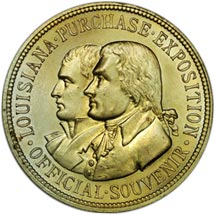


Since the days of the Roman Empire, medals have been prized for their aesthetic value and for centuries artists have found an eternal challenge in this medium of expression.  Certainly in our country there have been numerous outstanding sculptors, known as such to connoisseurs of American art but identified by numismatists largely as coin designers or medalists.  The very freedom of thought and expression provided these artists has produced many so-called dollars of diverse and rare beauty.  Pursuit of such a collection, while sometimes difficult is most rewarding.

Monday, January 24, 2011

Mint Engraver: James Barton Longacre

This article is taken from http://uspatterns.com/jambarlon.html

James Barton Longacre was appointed chief engraver of the United States Mint on September 16, 1844, after the death of Christian Gobrecht. He served in the post until his death on January 1, 1869.

Longacre's work was on the: 
Liberty Head used on the 1848 gold $1 and $20
Indian Princess gold $1 and $3 of 1854
Indian Princess pattern silver coins of the late 1860s
two-cent piece
Shield nickel
five-cent pieces of the 1860s
Indian Head cent
This is but a short list, and many other items could be added. In total, Longacre's dies were used on hundreds of different pattern coins and trial pieces.
Through the influence of John C. Calhoun, Longacre was appointed as chief engraver at the Mint on September 16, 1844, to succeed the late Christian Gobrecht. While Gobrecht had been a medalist and coin engraver of high repute, Longacre's experience in the medium of struck pieces was limited or nonexistent. However, he was a talented artist, seems to have learned quickly, and by 1849 created his first major new coinage design, the Liberty Head for the gold dollar and double eagle, this project being quite complex and bringing criticism to the engraver when problems were found with the high relief of the portrait. However, adjustments were made, and the design endured on the double eagle until well into the following century, to 1907.
 
At the Mint during his tenure, particularly in the late 1850s and through the 1860s, various local engravers assisted him, these including William Barber and Anthony C. Paquet-both of whom became well known-and, less well known, P.F. Cross and William H. Key. The latter had an active business in Philadelphia and produced many store cards, tokens (including many connected with the Civil War series), and medals. Neither Cross nor Key are remembered or cited in the annals of pattern coinage, although no doubt they did some of the work on dies we associate with Longacre.
The chief engraver seems to have had little patience with certain of his associates and superiors in the Mint and thus became involved in several notable disputes. In particular, for a long time he was opposed by Chief Coiner Franklin Peale, who ran his own private business using Mint facilities and who was involved in many shenanigans, until he was fired by President Franklin Pearce in December 1854, after which point Longacre had an easier time.
  
Longacre remained chief engraver until his death on January 1, 1869.  In 1928 the New York Public Library mounted an exhibit of the work of 100 notable American engravers, including works by Longacre. In October 1985 in The Numismatist, in "Longacre, Unsung Engraver of the U.S. Mint," an article by Tom DeLorey, sketched the biography of this important 19th-century man, an engraver who was misunderstood in his time, but who later became a household word in the numismatic community. The DeLorey text was illustrated by sketches and photographs of patterns, a number of which had not been published earlier.

Saturday, January 22, 2011

The 1933 Gold Double Eagle - World's Most Valuable Coin

This is reprinted from an About.com Guide article by Susan Headley 

The 1933 Gold Double Eagle was Never Officially Issued:

The U.S. Gold Double Eagle, Saint-Gaudens type, had been issued from 1907 until 1932. Although 445,500 Double Eagles had been minted with the 1933 date, none were released into circulation because of changes made to currency laws during the Great Depression. In an effort to end the run on the banks and stabilize the economy, President Franklin Roosevelt took America off the gold standard. Not only were no more gold coins to be issued for circulation, people had to turn in the ones they had.

The 1933 Double Eagles are Ordered to be Destroyed:

It became illegal for private citizens to own gold coins, unless they clearly had a collectible value. This law was enacted during desperate times to prevent the hoarding of gold currency. Since there would be no more gold currency issued in the U.S., the Mint had melted down the 1933 run of Gold Double Eagles and converted them to gold bullion bars by 1937.

Some of the Double Eagles Escaped the Melt Down:

Two of the 1933 specimens were given by the Mint to the U.S. National Numismatic Collection at the Smithsonian Institute. These were the only two legal specimens to ever become part of a coin collection; however, by 1952, the Secret Service had confiscated 8 more 1933 Double Eagles! How did they leave the Mint? Why weren't they melted down?

Was the 1933 Double Eagle Switched for Another Coin?:

We may never know for certain how these coins left the Mint, but there is a general consensus among scholars that a Mint cashier by the name of George McCann exchanged about 20 1933's doomed for destruction and replaced them with earlier dated Double Eagles. This way, the accounting books would balance and nobody would realize that anything was amiss.  What we do know for sure is that a Philadelphia area jeweler by the name of Israel Switt came into possession of at least 19 of the coins.

The Coin of a King:

Israel Switt sold at least 9 of the 1933 Double Eagles privately to collectors, one of which found its way into the collection of King Farouk of Egypt. When the Secret Service discovered that these coins had surfaced, they confiscated them all because they were considered to be stolen property of the U.S. Mint. However, King Farouk had legally exported his coin before the theft was discovered, and the Secret Service was unable to recover his specimen through diplomatic channels.

The King's Specimen is Recovered in a Sting Operation:

After King Farouk was deposed in 1952, his 1933 Double Eagle briefly appeared on the market, but when it became clear that U.S. authorities still wanted to confiscate it, it vanished again! More than 40 years later, British coin dealer Stephen Fenton showed up with it in New York, and the Secret Service finally seized it during a sting operation during which they purportedly negotiated to purchase the coin.

The 1933 Double Eagle is Nearly Destroyed by Terrorists:

Fenton fought a several year-long legal battle in the U.S. courts over ownership of the coin, during time which it was stored in the Treasury Vaults at the World Trade Center. A mere 2 months before the terrorist attacks of September 11, 2001, the lawsuit was settled and the Double Eagle was moved to Fort Knox. Fenton and the U.S. Mint had come to a compromise: the coin would be sold at auction, with the proceeds split between the Fenton and the Mint.

Legal Tender at Last - and the Most Valuable Coin in the World:

The 1933 Double Eagle sold at auction on July 30, 2002, for $6.6 million, plus the 15% buyer's fee, which brought the total cost to the buyer to $7,590,000, plus $20 to monetize the coin and compensate the Mint for the $20 it believes it lost when the coin was thought to have been stolen. The buyer chose to remain anonymous, so once again we don't know where the Farouk specimen is, or when it might suddenly show up again. One thing is for sure: the Secret Service can't confiscate it any more!
In September of 2004, Joan Langbord, one of Israel Switt's heirs, discovered ten more specimens of the 1933 Double Eagle amongst his effects. Apparently unaware of the legal status of these coins (or perhaps just a bit too trusting of the government) she sent all ten specimens to the U.S. Mint to have them authenticated. The Secret Service declared the coins to be seized, and now Langbord is fighting the government over ownership while the specimens languish at Fort Knox. It will be interesting to see, should the 10 Langbord coins ever come to market, if the 1933 Double Eagle will retain its place as the world's highest priced coin when the number of available specimens increases ten-fold.

http://www.usacoinbuyers.com/

Friday, January 21, 2011

Coin Grading Guide: Walking Liberty

This article is taken from the NGC's website.  We hope you will enjoy this unique review of our nation’s coinage.

Grading Walking Liberty Half Dollars (1916-1947)


Almost everyone's short list of favorite coin types includes the Walking Liberty half dollar. The United States Mint didn't share that view, however, as coins of this type were very difficult to strike; even proofs sometimes lacked complete details.

The Mint's Engraving Department attempted to correct this problem by sharpening the obverse master hub on several occasions, but the fundamental problem of poor metal flow into the dies proved insurmountable. This fact presents a challenge when attempting to grade Walking Liberty halves, as many of the pieces coined during the 1920s and earlier seem worn even when fully lustrous. This also is true of some of the branch mint issues of the '30s and '40s, particularly those coined at the San Francisco Mint.

Circulated halves are quite popular with collectors, though these coins did not wear evenly and can be unattractive in grades below Fine. The guidelines and photographs presented in The Official American Numismatic Association Grading Standards for United States Coins are very useful in determining the grades of circulated coins. This book also offers detailed descriptions of each Mint State grade level, though the most effective teaching tool is always hands-on experience.

The figure of Liberty and the eagle were both quite susceptible to contact marks from other coins, both before and after leaving the mint. These elements are in high relief and received only slight protection from the raised rims. As with any coin type, the Walking Liberty half dollar features certain areas where contact marks or hairline scratches have a greater impact on grading than they do in other areas. These are described in the ANA's guide as Prime Focal Areas and include the obverse field at the right (above the motto IN GOD WE TRUST) and the eagle's breast, left leg and left wing. Any surface disturbance occurring in these areas weighs heavily in lowering a coin's grade. Secondary Areas include the obverse field at the left, the sun's face and rays, Liberty's right arm, the flag drapery below it and the date area. Contact marks or hairline scratches located in these places still affect a coin's grade, but to a lesser degree.

Toning also is a grading issue with Walking Liberty halves. Coins of this type typically tone in an irregular and sometimes quite unattractive pattern. They're not likely to produce the beautiful concentric circles found on simpler designs. That's why you won't see very many toned Walkers in the marketplace, as many such coins have been "dipped" at some point to remove blotchy toning. There are exceptions, of course, and attractively toned examples may earn an extra grading point or the NGC star designation for superior eye appeal. Still, you should not be put off by dipped coins, particularly if their mint luster is unimpaired.

With their areas of exposed relief, Walking Liberty halves are particularly vulnerable to light stacking friction, or "rub" as it's sometimes called. This typically appears on Liberty's breasts, the breast and upper left leg of the eagle and the rims. Before the advent of certified grading, coins with such rub frequently were sold as mint state examples. These "sliders" are now graded AU-58, and that grade was devised specifically to describe such coins.
Before I conclude this discussion, a few additional words about striking quality are essential. The greatest deficiency in metal flow typically occurred at Liberty's left hand and the branch stem on the obverse, and at the eagle's breast and left leg on the reverse. Only on proofs dated 1936-42 are all of these elements brought up well, yet even some proofs are a bit indistinct in the shape of Liberty's hand. Many Denver and San Francisco Mint coins show additional weakness in Liberty's head, the olive branch and the date area. If severe, such weakness can lower the grade of a Mint State coin, and it can impair the wearing quality of circulated coins as well.

If you have any questions about buying or selling Walking Liberty half-dollars, please send us an email at info@usacoinbuyers.com and we can help you.

Wednesday, January 12, 2011

Satin Finish Mint Sets

Here is a great article we found on http://coinblog.org/:


The United States Mint has indicated that the "satin finish" will no longer be used for the annual Uncirculated Mint Set. This finish had been used for the sets since 2005. From 2011, a brilliant finish will be used.
The satin finish has a frosted look that is created by sandblasting the coin dies and burnishing the coin blanks. This created coins that were potentially in higher grades, provided they were not covered by contact or handling marks.
For some years such as 2005, higher grades are abundant. However, in the past two years, more often than not coins could not achieve the highest grades due to the aforementioned contact marks.
With the change, registry set collections will have less coins to worry about finding each year. Some interesting subsets are also created, consisting of satin finish coins issued from 2005 to 2010. Personally, I had been working on a satin finish Presidential Dollars Set. Now, I will try to complete this collection in earnest.
The scheduled release date for the 2011 Mint Set is February 8, 2011. This will be many months earlier than the release date set for the 2010 Mint Set.

Tuesday, January 11, 2011

Commemorative Stamp Collection


This is a great way to start a stamp collection or a great addition to a growing collection.  "Celebrate the Century" is an exciting, limited edition stamp series that commemorates the most significant people, events and accomplishments of the 20th Century. 

Monday, January 10, 2011

History of Money

Here is an interesting article we thought you might enjoy from by Michael Russell at  http://ezinearticles.com/?A-History-of-Coin-Collecting&id=447722


Today, it is believed that the first coins were bronze and used in China around 800-1,000BC. Lydia in Asia Minor used coins about 600-700 BC. The Lydian's coins were called "starters" which was a unit of weight. Starters were stamped with a lion's head image and made with a gold and silver alloy. Today, as you might guess, the coins that are still remaining are very valuable.


The early Americans did not use coins for money. They made their "notes" from beaver skins, wampum and tobacco. They had their own money system without coins in use until foreign traders came to America and demanded payment for their goods. The foreign coins then started to circulate, but soon Americans started making their own coins from copper in the 18th century. Then after the new American government was born, it started to regulate coinage. The rights to produce their own coins were eventually given to the states. Later, national coinage was produced in America and the first U.S. Mint building started their coining operations in Philadelphia in 1793. The Mint building was actually an old brewery! The cent coin was the first one struck for circulation.


It's amazing how these ingenious and enterprising early Americans operated their first Mints. They used a screw press that was powered by horses or many strong men! The planchets were squeezed between the obverse and reverse dies to strike the coins. At first, the dies were cut by hand. Sometimes a die cutter would add his own artistic flair to his dies.


Coin collecting has a long and colorful history and was mostly a hobby for the wealthy until more modern times. The Roman Emperor Augustus (63BC-14AD) was the earliest person known to collect coins. He collected them for his own collection and even gave out some as gifts. In the Middle Ages, the wealthy families and royalty amassed amazing collections. Even in the early history of America, only the wealthy could afford to collect coins. Everyone else had to spend the money for necessities such as food, shelter and clothing.


Then in 1858 the American Numismatic Society was formed and in 1891 the American Numismatic Association was founded. (A numismatist is a person who studies, collects or invests in paper money or coins). Because of these organizations, public awareness of coin collecting grew and in the 1930s the U.S. Commemorative coins were struck and became extremely popular with the public. More and more people were starting to collect and invest in coins. The numismatic hobby has been growing every since the 1930s and it is estimated that there are more that 15 million numismatists in the United States today!


Wednesday, January 5, 2011

Statehood Quarters

We have a complete stock all years of Statehood Quarters from 1999 through 2010.  We sell all years both individually or in albums as a set.


If you are missing, for instance, an Alaska P...send us an email and we can help to complete your collection.


Tuesday, January 4, 2011

Stamps 101, Part 3

This article is taken from the American Philatelic Society website.  http://www.stamps.org/kids/kid_qa.htm 
 
What makes a stamp valuable and how do you determine that value?
The value of a stamp is determined by the quantity available, the demand, and its condition. Approximate values, for both mint and used items, can be obtained from a stamp catalog.
Is it better to collect canceled or mint stamps?
This is a decision that collectors must make for themselves. Canceled stamps with light markings can make a beautiful and, of course, educational collection. They also usually are less expensive to obtain. It must be noted, however, that in general mint stamps will have a greater value in later years. This is not always true. One of the most valuable stamps, the 1 cent British Guiana, is a heavily canceled stamp.
What are the rarest or most expensive stamps?
There are more than ten stamps of which only one copy is known. And while rarity is one factor in determining value, the history behind the stamp often is more important. Some of the most famous and valuable stamps include:
  • 1 cent 1856 British Guiana (Sold for $935,000 in 1980)
  • 1d and 2d 1847 Post Office Mauritus (1d & 2d valued at $500,000 used; 1d at $1,100,000 unused)
  • Sweden 1857 3 skilling Banco Yellow (Approximately $2,000,000)
  • Hawaiian Islands 1851 2 cent Missionary ($660,000 unused; $200,000 used)
  • British Guiana 1851 2 Cent Cottonreel ($70,000 used)
  • Western Australia 1854 4d Inverted Swan ($60,000 used)
  • United States 1868 1 cent Z Grill (Sold for $935,000 in 1988)
  • Canada 1851 12 pence Victoria on Laid Paper ($80,000 unused and $50,000 used)
  • United States 1918 Inverted Jenny ($150,000 unused)
The above values are based on catalog values or last known sales.
Why isn't there just one stamp with all different prices?
If all stamps appeared the same, Postal clerks and customers would be more likely to confuse them. In fact for a period of years the Universal Postal Union required that stamps had to be a particular color based on the rate they paid. Another important consideration is that stamps give us an opportunity to honor our great citizens, commemorate important events in our history and encourage our citizens to do things that help our society to work well, such as register to vote, and to give blood.
Why do people collect stamps?
People collect stamps for many different reasons. Some like to learn about the designs. Others enjoy them as little art works. Still others like to try to get all the stamps of one country. But most of all, stamp collectors have fun with their stamps because no collection is ever complete, so there is always a challenge. Besides, your stamps belong to YOU, and that is a nice feeling. And, of course, stamps are one way of sharing an interest with other people -- your friends, a parent or perhaps a neighbor. Even strangers can be instant friends when they discover that they both collect stamps!
How old must a stamp be before it's worth more than face value?
A stamp becomes valuable because there are fewer copies of it than there are collectors who want it. Age of the stamp is only one factor. Also important are how many were printed and how many collectors there are. There are some stamps that are 100 years old but a billion or more were printed. They will never be rare.
How and where do you get stamp catalogs, tools, and mounts?
Most often, people get stamp supplies, catalogs and stamps from stamp dealers. Visit the dealer listing on this website or look in the yellow pages of your telephone book under "stamps" or "stamps for collectors," and call before you visit to make sure that the dealer carries the things you need. If there is no local dealer, you need to find adult collectors who can tell you where they get what they need -- usually by mail. Sometimes a member of a local stamp club (see listing on our site) will order supplies for the club members, and you can submit your order with the club order.
Why are stamps canceled?
Stamps represent money that has been paid to the Postal Service. The money that is collected from selling stamps is used to pay the expenses of transporting and delivering the mail. Once stamps have been used, the cancellation makes them into a receipt for the service that the Postal Service has given. If more service is asked for in the form of a new letter, a new stamp must be used.
Where can I put my stamps if I don't have hinges or mounts?
Without hinges or mounts it will be difficult to display your stamps in an album or on home made pages because tape or glue will damage your stamps. You could use glassine envelopes or stock cards, but stamp hinges are less expensive. Self-stick pages sold for photographs should not be used, as the stamps may be hard to remove, and when the adhesive dries, it may discolor your stamps.
If you have a design you think would make a good stamp, where do you send it for people to look at?
Stamp design ideas should be sent to:
Citizens' Stamp Advisory Committee
Stamp Development
US Postal Service
1735 North Lynn St., Rm 5013
Arlington, VA 22209-6432


Saturday, January 1, 2011

New Blog for BJ's Stamps and Coins

We have a new blog!  Things will be updated with news, articles and just general information about coin and stamp collecting.


Please also visit our BJ's Stamps and Coins Facebook page! 


Check back often for new posts! 
Happy collecting!