
Have fun going through your old jars of coins. You never know what you might find hidden in your collection. This is taken from an article on www.blifaloo.com
 Background: Most circulating pennies at that time were struck in zinc-coated steel because copper and nickel were needed for the the war.
In 2008, Steve Contursi sold a 1943-S authenticated copper wheat penny for more than $100,000 to a private collector. Contursi had bought the coin only a week earlier for about $72,000.
How to spot it: The easiest way to determine if your 1943 cent is copper (and valuable) is to test it with a magnet. If it sticks to the magnet, it is a steel penny, and not valuable (but still pretty nifty).
If it does not stick, then you might have hit the jackpot...have a expert authenticate your coin, but be prepared for disappointment: there are probably many counterfeits of this coin. More info about 1943 Pennies on Wikipedia
1982 "No P" Dime
Coin: 1982 "No P" Dime
Estimated Value: $100+ (just saw one on ebay for $3000)
 Background: Before 1980, dimes minted in Philadelphia didn't have a mint mark. Starting that year, a small letter "P" was placed on Philly dimes above the date.
Estimated Value: $300 - $25,000+
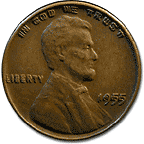 About 24,000 1955 double die cents were put into circulation.In uncirculated condition, the 1955 Double Die wheat penny is worth over $25,000. Even circulated versions of the 1955 Double Die are worth $300-$1000+ depending on condition.
How to spot it: The doubling of the letters and numbers on this coin is pretty easy to see. Rare, but not too rare... these pop-up at auction every once and a while.
Estimated Value: $400 - $3000

 Beginning in 1965 dimes were made out of copper and nickel. A silver 1965 dime is a mistake (and a rare one). Only a few have been found, but more are believed to still be in circulation.
How to spot it: The silver coin has a silver edge; the common copper/nickel coin has a strip of brown around the edge.
A silver dime weighs 2.50 grams, while a copper/nickel dime weighs 2.27 grams
5 Rare and Valuable US Coins
1943 Copper Penny
Coin: 1943 Copper Penny
Estimated Value: $10,000 - $100,000+
Estimated Value: $10,000 - $100,000+
Background: Most circulating pennies at that time were struck in zinc-coated steel because copper and nickel were needed for the the war.About 40 1943 copper cents are estimated to remain in existence, and only about a dozen confirmed to exist.
They were most likely made by accident when copper blanks remained in the press as production began on the new steel pennies. In 2008, Steve Contursi sold a 1943-S authenticated copper wheat penny for more than $100,000 to a private collector. Contursi had bought the coin only a week earlier for about $72,000.
How to spot it: The easiest way to determine if your 1943 cent is copper (and valuable) is to test it with a magnet. If it sticks to the magnet, it is a steel penny, and not valuable (but still pretty nifty).
If it does not stick, then you might have hit the jackpot...have a expert authenticate your coin, but be prepared for disappointment: there are probably many counterfeits of this coin. More info about 1943 Pennies on Wikipedia
1982 "No P" Dime
Coin: 1982 "No P" Dime
Estimated Value: $100+ (just saw one on ebay for $3000)
Background: Before 1980, dimes minted in Philadelphia didn't have a mint mark. Starting that year, a small letter "P" was placed on Philly dimes above the date. In 1982 an error occurred when the mint mark was omitted from a small number of dimes, leaving them p-less.
How to spot it: 1982 dime, with no "p" above the date. Of course, this could be easy to fake -- an expert would need to authenticate the coin. 1955 Double Die Penny
Coin: 1955 Double Die PennyEstimated Value: $300 - $25,000+
Background: Double dies are caused when from a misalignment during the production of a coin.
About 24,000 1955 double die cents were put into circulation.How to spot it: The doubling of the letters and numbers on this coin is pretty easy to see. Rare, but not too rare... these pop-up at auction every once and a while.
2001-P Double Struck New York Quarter
Coin: 2001-P Double Struck New York QuarterEstimated Value: $400 - $3000
Background: The coin is sadistic and is not satisfied being struck once. A production goof keeps the coin in the chamber for extra striking making a very odd looking coin.
How to spot it: Off center image doubling of Washington and the Statue of Liberty.
1965 Silver Dime
Coin: 1965 Silver Dime
Estimated Value: $9000+
Estimated Value: $9000+
Background: The official production of silver dimes were discontinued in 1964.
Beginning in 1965 dimes were made out of copper and nickel. A silver 1965 dime is a mistake (and a rare one). How to spot it: The silver coin has a silver edge; the common copper/nickel coin has a strip of brown around the edge.
A silver dime weighs 2.50 grams, while a copper/nickel dime weighs 2.27 grams


